Case Study
A Quill.org Pilot with Baton Rouge Community College • With Support from Axim Collaborative
How Targeted Writing Practice Boosted First-Year Composition Pass Rates
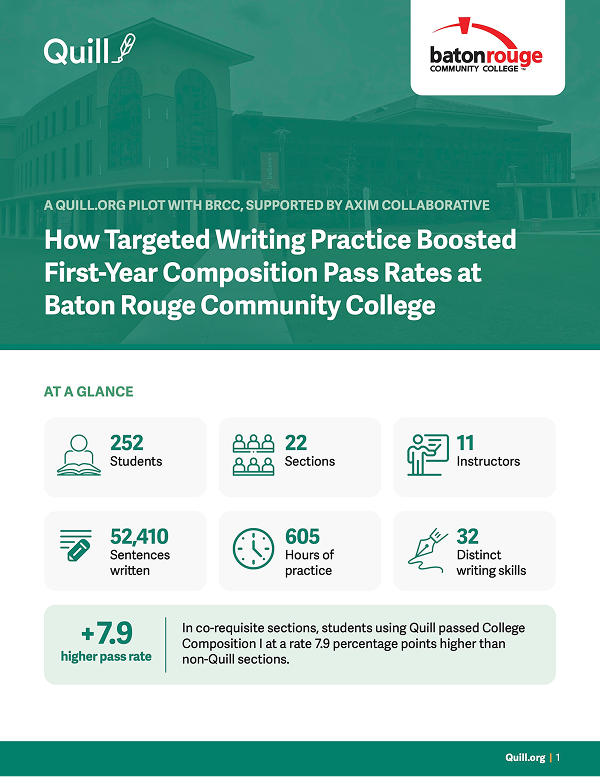
A Fall 2025 pilot across 22 first-year composition sections shows how individualized, data-driven writing practice can move the needle on the outcomes community colleges care about most.
+7.9%
In co-requisite sections, students using Quill passed College Composition I at a rate 7.9 percentage points higher than students in non-Quill sections.
At a Glance
The Pilot, by the Numbers
252 students, 11 instructors, and 22 sections
-
52,410
Sentences Written
-
605
Hours of Practice
-
32
Distinct Writing Skills


The Challenge
The Gateway Course Problem in Community Colleges
First-year composition is one of the most consequential courses in higher education. Along with introductory math, it is the course that most often prevents community college students from graduating. When students fail or withdraw, the effects compound: delayed progress, lost financial aid eligibility, and too often, leaving college altogether.
A national shift away from standalone remediation toward the co-requisite model expands access but concentrates the work. Instructors must help underprepared students build foundational writing skills and meet college-level objectives in a single semester, with little class time to spare. BRCC — an open-admissions institution where 67% of students are first-generation and the average age is 25 — knows this challenge well.
“We don’t have a lot of time to go over grammar in class. I used to just have to tell students to Google it.”
The Solution
Built for Community College Composition
In Fall 2025, BRCC formalized its Quill implementation across 22 sections — primarily co-requisite developmental English and gateway College Composition I — taught by 11 instructors. Students took a Quill Diagnostic early in the semester, then completed personalized practice as graded homework, following Quill’s three-step diagnostic pathway.
-
Diagnose
A short assessment identifies each student’s specific skill gaps in grammar, mechanics, and sentence construction.
-
Practice
Quill generates individualized practice for every student. Instructors assign it as weekly homework counting toward course grades.
-
Measure growth
A Growth Diagnostic at semester’s end measures progress on the same skills, giving a clear before-and-after picture.

Built on Quill Premium
Canvas single sign-on, reporting dashboards, personalized professional learning, and a dedicated customer success manager reduced friction and drove adoption.
“It’s individualized. It’s tailored to what you need. Why should you have to work on capital letters if you already know what needs to be capitalized?”
The Headline Result
Stronger Outcomes in a Gateway Course
Among co-requisite developmental English students enrolled in College Composition I, sections using Quill significantly outperformed non-Quill sections.
+7.9%
In co-requisite sections, students using Quill passed College Composition I at a rate 7.9 percentage points higher than students in non-Quill sections.
C or Better
- Quill Sections
- 54.2%
- Non-Quill
- 46.3%
+7.9 pp
Drop, Fail, Withdraw (DFW) Rate
- Quill Sections
- 45.8%
- Non-Quill
- 53.7%
-7.9 pp
Year-over-Year Improvement
Quill sections also outperformed BRCC’s Fall 2024 baseline, where only 44% of co-requisite students earned a C or better — a 10.4-percentage-point improvement year over year.
What Students Practiced
Top 10 Most-Completed Practice Activity Packs
Work was concentrated in Quill Connect, the platform’s sentence-combining tool, supplemented by Quill Grammar and Quill Proofreader. Roughly 90% of co-requisite students placed at the Starter level, focused on foundational mechanics, while gateway students worked at Intermediate and Advanced levels.
| Rank | Activity Pack | Sentences Written |
|---|---|---|
| 1 | Plural Possessive Nouns | 3,130 |
| 2 | Complex Sentences | 3,130 |
| 3 | Subject vs. Object Pronouns | 2,720 |
| 4 | Compound Sentences | 2,610 |
| 5 | Simple Appositive Phrases | 2,510 |
| 6 | Conjunctive Adverbs | 2,490 |
| 7 | Capitalization of People & Places | 2,460 |
| 8 | Basic Subject-Verb Agreement | 1,940 |
| 9 | Advanced Subject-Verb Agreement | 1,890 |
| 10 | Plural vs. Possessive Nouns | 1,870 |
Measured Growth
Practice on the Right Skills Produced Real Growth
The growth data — comparing each student’s baseline diagnostic to their end-of-semester growth diagnostic — tell a clear story: students improved most on the skills most central to college-level writing.
| Skill | Proficiency, pre- and post-diagnostic | Change |
|---|---|---|
| Plural vs. Possessive Nouns | +18% | |
| Subject vs. Object Pronouns | +18% | |
| Capitalization of People & Places | +8% | |
| Basic Subject-Verb Agreement | +7% | |
| Your vs. You’re | +6% | |
| Advanced Compound-Complex Sentences | +32% | |
| Simple Appositive Phrases | +27% | |
| Compound Sentences | +24% | |
| Basic Compound-Complex Sentences | +19% | |
| Conjunctive Adverbs | +13% |
The number of students who were proficient in advanced compound-complex sentences and appositive phrases — the exact sentence structures that distinguish strong college essays from weak ones — more than doubled. A student who can construct a compound-complex sentence isn’t just demonstrating grammatical knowledge; they’re learning to express layered, argumentative ideas. That’s the work of College Composition I.
“I have seen them making fewer run-on sentences, fragments, and comma splices. And they’ve even progressed with working on their topic sentences and thesis statements.”
In Students’ Own Words
Building Confidence, One Sentence at a Time
-
“Quill plus an awesome English teacher actually made me excited to write rather than dreading the due date.”
First-Year Composition Student, BRCC -
“I feel more confident using Quill. It helps me catch mistakes and improve my writing, so revising is easier and less stressful.”
First-Year Composition Student, BRCC -
“When I write, I tend to pay more attention to how I’m wording my sentences, using more correct grammar.”
First-Year Composition Student, BRCC -
“When I was in school, I didn’t really learn where to put certain things, and Quill has helped me with that.”
First-Year Composition Student, BRCC
All surveyed BRCC instructors said they would continue using Quill. Among the six who completed the final survey, the average likelihood of recommending Quill to a colleague was 9.3 out of 10, with 5 of 6 scoring 9 or 10.
The Takeaway
What it Takes to Make Quill Work on a Community College Campus
The BRCC pilot surfaced four lessons, drawn from instructor interviews, student surveys, and usage patterns across sections.
-
Start with the diagnostic in week one
Tie practice to course grades. Instructors who assigned the diagnostic early saw stronger engagement all semester. “Don’t give it as a bonus. Give it as a required assessment.”
-
Leverage Canvas integration
Single sign-on was a turning point for adoption. Removing even one login step matters for students juggling multiple platforms — “all they have to do is click a button.”
-
Align practice with classroom instruction
The greatest impact came when Quill activities reinforced what students were learning in class, rather than feeling like a separate task.
-
Complete the full diagnostic cycle
Baseline plus growth diagnostic with targeted practice in between gives instructors and administrators a clear picture of each student’s development.
A note for writing support centers
Quill’s core focus is first-year composition — but the same diagnostic-driven practice is equally valuable in writing centers, tutoring programs, and academic support services. Personalized practice can extend the reach of writing center staff, supplement one-on-one tutoring, and give students structured skill-building between appointments.
These are observational results from a pilot. They are not the product of a randomized controlled trial and should not be interpreted as proof of causation. Section assignment, instructor effects, and student characteristics may contribute to the difference observed.
“I think Quill is going to be a permanent part of my classes.”
Bring Targeted Writing Practice to Your Campus
First-year composition is a high-stakes course at every community college. The early answer, from one pilot in Baton Rouge, is that targeted, data-driven practice can move the needle on course passage, retention, and completion.